
TABLE OF CONTENTS
Experience the Future of Speech Recognition Today
Try Vatis now, no credit card required.
How to Transcribe a Video file or YouTube video to Text for Free (2026): Step-by-Step Guide
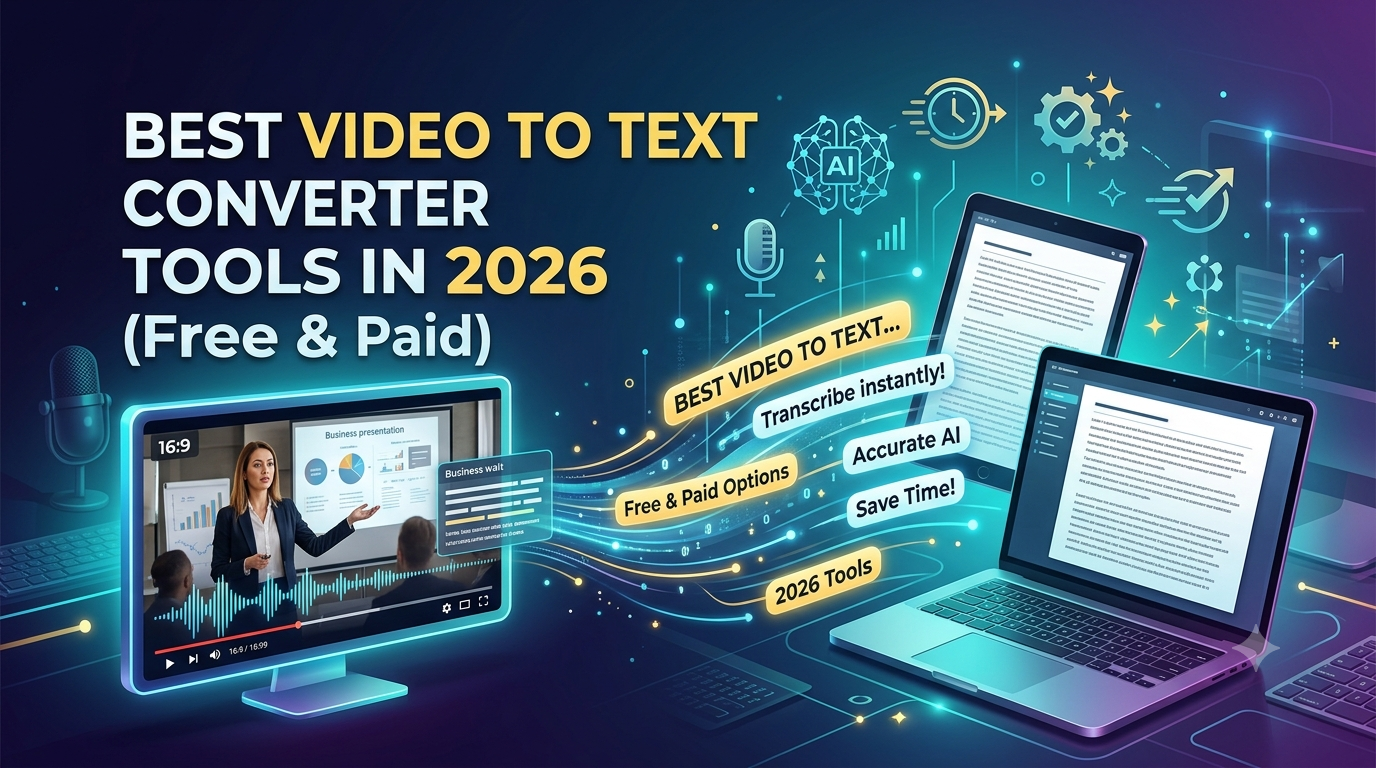
If you've ever needed subtitles for a clip, searchable notes from a webinar, or a blog post pulled from a YouTube video, you've run into the same question: how to transcribe a video to text without paying for expensive software or typing it all out by hand.
The good news is that you can do it for free in 2026. Speech recognition has improved enough that a clean recording can be turned into accurate, timestamped text in minutes. The right approach depends on where your video lives, how accurate it needs to be, and how much time you're willing to spend.
People transcribe video for a lot of reasons: creating captions and subtitles for accessibility, generating searchable meeting or lecture notes, repurposing long-form content into articles and social posts, or simply keeping a written record of an interview. Below are four methods to transcribe video to text free, ordered roughly from fastest to most labor-intensive, with honest tradeoffs for each.
Method 1: Use an AI Transcription Tool (Recommended)
This is the fastest and most accurate free option for most people. An AI transcription tool runs your audio through an automatic speech recognition model and returns text in seconds to a few minutes, complete with timestamps and (often) speaker labels. You don't need to play the video in real time, and you don't need any special hardware.
Here's the typical step-by-step workflow, using the free web tool transcribevideototext.com as a worked example:
- Upload your file. Drag and drop your video (MP4, MOV, or WebM) or audio file (MP3, WAV, or M4A) into the browser. No software install required. Or if you want to transcribe a YouTube, X or any video from a social media platform, install the skill into your Claude, ChatGPT or what you're using and you can transcribe any video.
- Pick or auto-detect the language. Good tools support 100+ languages and can auto-detect spoken language, which matters if your content isn't in English.
- Transcribe. Start the job and let the model process the audio. A few minutes of video usually takes well under a minute.
- Review with timestamps. Read through the transcript alongside word-level timestamps and speaker labels (diarization), so you can quickly fix any mishearings and identify who said what.
- Export. Download the result as plain text (TXT), a document (PDF), or subtitle files (SRT/VTT) ready to drop into a video editor or YouTube.
Tradeoffs: Free tiers have time limits. The tool above lets you try the first 3 minutes with no signup, gives 30 minutes with a free account, and unlocks 20 hours per month on a Pro plan at $12/month. AI accuracy is excellent on clean audio (often cited around 99% in ideal conditions) but still benefits from a quick human review on noisy recordings or heavy accents.
Method 2: YouTube Auto-Captions (Free, but Rough)
If your video is already on YouTube, the platform generates automatic captions for free. To read them, open the video, click Show transcript in the description (or the "..." menu), and the timestamped text appears beside the player and scrolls as the video plays. You can copy and paste this text into a document.
If you own the video, you can also go to YouTube Studio → Subtitles, select the video, and download the auto-generated track as an SRT or VTT file.
Tradeoffs: This only works for videos hosted on YouTube. Auto-captions are roughly 95% accurate for clear English but degrade quickly with background noise, accents, technical jargon, or overlapping speakers. There's no punctuation polish and no speaker labels, so you'll often spend time cleaning the output. For videos you don't own, you can't download a file directly — only copy the text.
Method 3: Google Docs Voice Typing or Manual Playback (Free, Tedious)
Google Docs has a built-in Voice Typing feature (Tools → Voice typing, works best in Chrome). It transcribes whatever it hears through your computer's microphone in real time. To transcribe a recording, you'd play the audio out loud near the mic and let Docs type it as it listens.
Tradeoffs: This is the slowest of the digital methods. Google Docs has no "upload a file and get a transcript" feature — it only listens to a live microphone, so a 60-minute video takes 60 minutes to transcribe, in real time. Playing audio through speakers into a mic also introduces noise that hurts accuracy. It's free and requires nothing but a browser, but for anything longer than a couple of minutes it's rarely worth the effort compared to Method 1.
Method 4: Manual Transcription or Hiring a Service (Most Accurate, Slow or Costly)
The old-fashioned approach: play the video, pause frequently, and type what you hear. Or hire a professional human transcription service to do it for you.
Tradeoffs: Human transcription delivers the highest accuracy, especially for difficult audio, multiple speakers, or specialized terminology that trips up AI. The cost is time or money. Typing it yourself can take 4x the length of the recording; professional services are accurate but typically charge per audio minute and take hours or days to return work. This method makes sense for legal, medical, or publication-grade transcripts where near-perfect accuracy is non-negotiable.
Best Free Tools to Transcribe Video to Text
A short shortlist if you want to skip straight to a tool:
- transcribevideototext.com — Free in-browser AI tool with auto language detection, speaker labels, word-level timestamps, and TXT/PDF/SRT/VTT export. Try 3 minutes with no signup; 30 minutes free with an account.
- YouTube Studio — Free auto-captions for videos you've uploaded; download as SRT/VTT. Best when your content already lives on YouTube.
- Google Docs Voice Typing — Free, browser-based, real-time dictation. Fine for short clips played near your mic, not for long files.
- Vatis Tech — A speech-to-text API for developers who want to build transcription directly into their own apps and workflows rather than using a web interface.
Tips for the Best Accuracy
No matter which method you choose, the quality of your input drives the quality of your transcript:
- Start with clean audio. Minimize background noise, avoid echoey rooms, and use a decent microphone when recording. Clear speech is the single biggest factor in accuracy.
- Choose the right language (or use auto-detect). Forcing the wrong language model produces garbled output. If your video mixes languages, pick a tool that handles that.
- Use speaker labels for multi-person video. Diarization makes interviews, panels, and meetings far easier to read and edit.
- Always do a quick review. Even 99% accuracy means a handful of errors per thousand words — proper nouns, jargon, and homophones are common culprits. A two-minute skim catches most of them.
FAQ
Is it really free to transcribe a video to text? Yes. YouTube auto-captions and Google Docs Voice Typing are completely free, and AI tools offer free tiers (for example, 3 minutes with no signup and 30 minutes with a free account). Heavy or long-form use may require a paid plan.
How accurate is automatic video transcription? Modern AI transcription reaches around 99% accuracy on clean, clear audio. YouTube auto-captions sit closer to 95% for clear English. Accuracy drops with background noise, accents, jargon, and overlapping speakers — so review is always wise.
Can I get subtitles from my video? Yes. AI tools and YouTube Studio can export timestamped subtitle files in SRT and VTT formats, which drop straight into video editors and YouTube. Word-level timestamps make subtitle timing far more precise.
Which export formats are available? It depends on the tool. The most useful options are TXT (plain text), PDF (formatted document), and SRT/VTT (subtitles). Pick TXT for notes or articles, and SRT/VTT for captions.
Whichever method fits your video, transcribing it to text is faster and cheaper in 2026 than ever before. For most people, an AI tool strikes the best balance of speed, accuracy, and cost — start there, then fall back to manual methods only when near-perfect output is essential.