
TABLE OF CONTENTS
Experience the Future of Speech Recognition Today
Try Vatis now, no credit card required.
Imagine your best agent cloned—an expert who knows every policy, remembers every customer detail, and never gets flustered. Now, what if you could give a piece of that expertise to every single person on your support team, in real-time, during a live call? That's the promise of real time agent assistance.
It’s not about replacing humans with bots. It’s about empowering them with an AI co-pilot that listens in on conversations and instantly provides the right information, right when they need it.
What Is Real Time Agent Assistance, Really?
At its core, real time agent assistance is a type of software that acts as an intelligent guide for your agents during live calls and chats. Using AI—specifically real-time voice recognition and natural language understanding (NLU)—it analyzes the conversation as it happens and pushes context-aware support directly to the agent's screen.
Think of it as a GPS for customer service. It offers turn-by-turn directions to guide the agent toward the fastest, most effective resolution. For example, when a customer says, "I want to return this," the system doesn't just hear the words; it understands the intent and instantly shows the agent the 3-step return process on their screen.
This technology finally bridges the gap between genuine human connection and the speed of machine intelligence. While your agent focuses on listening and showing empathy, the AI is in the background, doing the heavy lifting of sifting through knowledge bases or reminding them of compliance steps. In many ways, it's a specialized AI agent for customer service built to augment, not automate.
The Co-Pilot for Your Contact Center
The main goal here isn't to take over the conversation; it's to make your human agents better, faster, and more confident. It directly tackles the classic pain points that lead to bad customer experiences and high agent turnover.
- No More "Let Me Put You on Hold": Instead of making a customer wait while the agent frantically searches a clunky knowledge base, the system instantly surfaces the exact article or script needed.
- Consistency is Key: It feeds agents standardized answers and guides them through proper procedures. This ensures every customer gets the same high-quality service, no matter who they talk to.
- Less Stress, Better Support: By providing a safety net of information and compliance nudges, it takes a massive cognitive load off the agent. They can focus on the customer, not on remembering obscure details.
The market's explosive growth tells the story. Once a niche technology, real-time AI agent assistance was valued at $4.4 billion in 2024. Fast forward to today, and projections show it skyrocketing to $124.6 billion by 2034, growing at an incredible compound annual rate of 39.70%. This isn't just a trend; it's a fundamental shift in how modern businesses run their customer support operations.
Core Functions of Real Time Agent Assistance at a Glance
So, what’s actually happening behind the curtain during a live call? It’s not just one thing—it’s a whole suite of tools working together seamlessly, all powered by a foundation of powerful conversational AI that can understand human speech and intent in milliseconds.
The table below breaks down these key capabilities and shows the direct line between a function and its impact on both your agents and your customers.
| Core Function | What It Does for the Agent | Immediate Customer Benefit |
|---|---|---|
| Real-Time Transcription | Provides a live, searchable transcript of the conversation as it happens. | The customer doesn't have to repeat themselves. |
| NLU & Intent Detection | Identifies the customer's goal (e.g., "billing issue," "return request"). | The conversation gets to the point faster. |
| Automated Knowledge Retrieval | Instantly surfaces the right help article, script, or policy. | Quick, accurate answers without long holds. |
| Sentiment Analysis | Flags customer frustration or satisfaction in real-time. | The agent can de-escalate issues proactively. |
| Compliance & Script Adherence | Displays on-screen reminders to follow required scripts or disclosures. | Ensures a consistent and legally compliant experience. |
| Next-Best-Action Suggestions | Recommends the most logical next step to solve the problem. | The issue is resolved efficiently on the first try. |
Each of these functions contributes to a system that doesn't just react but actively anticipates what the agent and customer will need next.
The system acts as an intelligent co-pilot that surfaces relevant information within milliseconds. It uses accurate speech recognition to process speech in real-time to understand context, detect sentiment, and predict the best course of action.
This proactive support transforms your contact center from a reactive cost center into a proactive, experience-driven powerhouse. By giving agents the right tools at the perfect moment, you can dramatically improve first-call resolution, boost CSAT scores, and make your entire operation more efficient from day one.
The Business Case for Empowering Your Agents
Let’s get straight to the point. Beyond the bells and whistles, the real measure of real-time agent assistance is its impact on your bottom line. This isn't just another software upgrade; it's a strategic move that delivers tangible returns by transforming the very core of your contact center.
The numbers speak for themselves. Businesses implementing AI-driven customer support are seeing a 3.5x to 8x return on their investment. Projections show that by 2026, 80% of routine customer interactions will be handled by AI, highlighting a massive shift in the industry. You can dig into more of these AI customer support statistics on Chatmaxima.com.
This isn't a trend—it's a fundamental change driven by a clear and compelling business case.
Supercharge Agent Performance
One of the first things you'll notice is how quickly your agents, especially new hires, get up to speed. The traditional months-long onboarding process, filled with shadowing and slow knowledge building, becomes a thing of the past.
Picture a new agent in their first week. They get a call with a complex billing question that would normally send them scrambling for a supervisor. Instead, their screen instantly shows the exact steps to fix the problem. What could have been an escalation becomes a first-call resolution. This is on-the-job training at its best, building real competence and confidence from day one.
- Slash Onboarding Time: New agents become productive in weeks, not months, thanks to live, contextual guidance.
- Reduce Critical Errors: Automated compliance prompts make sure agents stick to the script, helping you avoid costly fines and legal trouble.
- Boost Agent Confidence: With a "co-pilot" suggesting what to do next, agents feel supported and less stressed, which directly impacts employee turnover.
Deliver a Superior Customer Experience
Your customers want one thing: their problems solved quickly and correctly. They don't care about your internal workflows. Real-time agent assistance hits this nail on the head by making your service faster and more consistent.
When agents have information at their fingertips, they can stop searching and start listening. For example, a customer calls about a product return. The system instantly pulls up their order history and your return policy. The agent has everything they need without ever uttering the dreaded words, "Please hold while I look that up."
This seamless access to knowledge means faster resolutions, higher first-call resolution rates, and a significant boost in customer satisfaction (CSAT) scores. Consistency becomes the standard, not the exception.
Optimize Operational Efficiency
When your agents are more effective and your customers are happier, operational efficiency naturally follows. By giving agents tools that cut out manual, repetitive work, you unlock major cost savings and boost your team's overall capacity. The backbone of this efficiency is often a highly accurate speech-to-text engine for your call center that reliably captures every word.
The impact on your key metrics is immediate and obvious.
| Operational Metric | How Real-Time Assistance Improves It | Tangible Business Outcome |
|---|---|---|
| Average Handle Time (AHT) | Wipes out the need for manual knowledge searches and long holds. | Lowers your cost-per-call and increases agent capacity. |
| First-Call Resolution (FCR) | Feeds agents accurate, instant answers to solve issues on the spot. | Slashes the number of repeat calls and frustrated customers. |
| Agent Occupancy | Helps agents handle more interactions per shift without burning out. | Maximizes the productivity of your existing team. |
By connecting these features directly to bottom-line results, you can build a powerful business case. You're not just buying software; you're investing in a system that cuts churn, drives revenue, and builds a more scalable and effective support operation.
How Real Time Agent Assistance Works
So, how does agent assistance actually work in real-time? It's not magic, but it might as well be. The entire process, from the moment a customer speaks to the instant a helpful tip appears on your agent's screen, happens in a fraction of a second.
Let’s break down the technology that makes this possible. It's a chain of events where each link depends on the one before it, all working together to turn spoken words into on-screen guidance.
Step 1: The System's Ears (Real-Time Transcription)
It all starts with the system's 'ears': real-time transcription. As soon as the customer and agent start talking, their speech is captured and converted into text almost instantly. We’re talking about sub-300-millisecond latency here—so fast it feels like it’s happening live.
The accuracy of this first step is everything. If the transcription is garbage, everything that follows will be too. That's why modern platforms use powerful Automatic Speech Recognition (ASR) engines trained on thousands of hours of real contact center audio. This allows them to cut through background noise, understand different accents, and recognize specific industry jargon.
If you want to go deeper on this foundational tech, check out our guide on how automatic speech recognition works.
Step 2: The Brain (Natural Language Understanding)
With the conversation converted to text, it’s sent to the system’s ‘brain’—Natural Language Understanding (NLU). This is where the AI moves beyond simply hearing words to actually understanding what they mean. The NLU models get to work analyzing the text to figure out the customer's intent, their emotional state, and any key details they mention.
- Intent Detection: Is the customer asking for a refund, trying to pay a bill, or updating their contact info? The AI pinpoints the goal of the conversation.
- Entity Extraction: It identifies and pulls out critical pieces of information like account numbers, product names, tracking IDs, or dates.
- Sentiment Analysis: The system reads the emotional tone of the conversation. Is the customer frustrated, happy, or neutral? This context helps the agent tailor their response with the right amount of empathy.
For example, a customer saying, "I'm really upset, my latest bill is wrong," immediately triggers the NLU. It flags the intent as a "billing issue" and notes the negative sentiment ("upset"), instantly preparing to find solutions for billing problems. This is the crucial leap from raw text to actionable intelligence.
This infographic shows how real time agent assistance helps new agents quickly become experts, contributing to a more efficient team.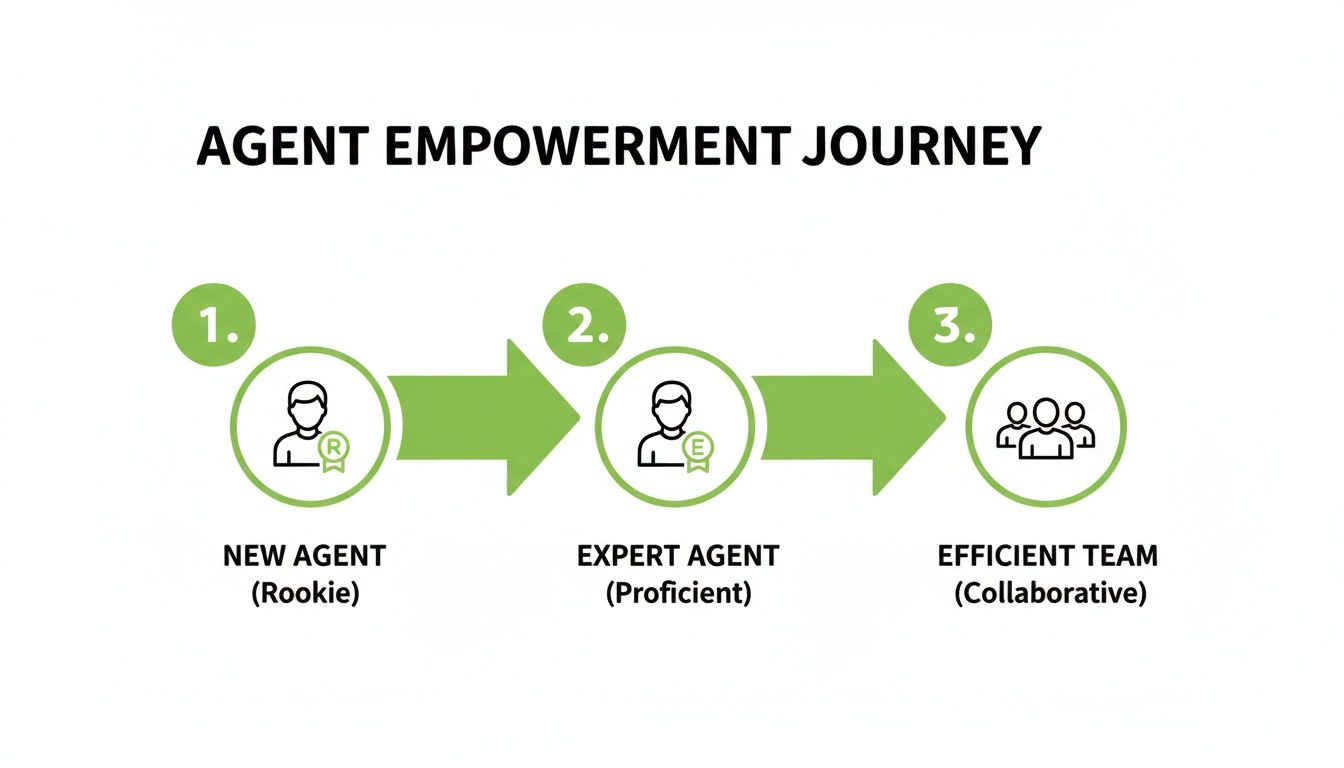
The visualization clearly shows that by providing on-the-job guidance, the technology accelerates an agent's journey from novice to expert, improving overall team performance.
Step 3: The Librarian (Knowledge Retrieval and Final Output)
Once the system understands what the customer needs, it acts like a super-fast, hyper-organized librarian. This is the knowledge retrieval stage. The insights from the NLU are used to search all connected resources—your internal knowledge base, CRM records, product manuals, and even historical interaction data.
But it doesn't just dump a list of search results on the agent. The system finds the single best answer, script, or step-by-step process and presents it directly on the agent's screen through a simple UI overlay. This is the "aha!" moment, where the agent gets the exact information they need, right when they need it most.
By combining ultra-fast transcription, deep language understanding, and rapid knowledge retrieval, the platform delivers a seamless flow of support that feels like magic but is actually a well-orchestrated technological process.
The growth in this area is part of a much larger movement. The broader AI agents market is projected to reach a valuation between $7.6 and $7.63 billion in 2025. Analysts predict that 33% of enterprise software applications will include this type of agentic AI by 2028, signaling a widespread shift from back-office automation to front-line decision support.
Real World Applications Across Industries
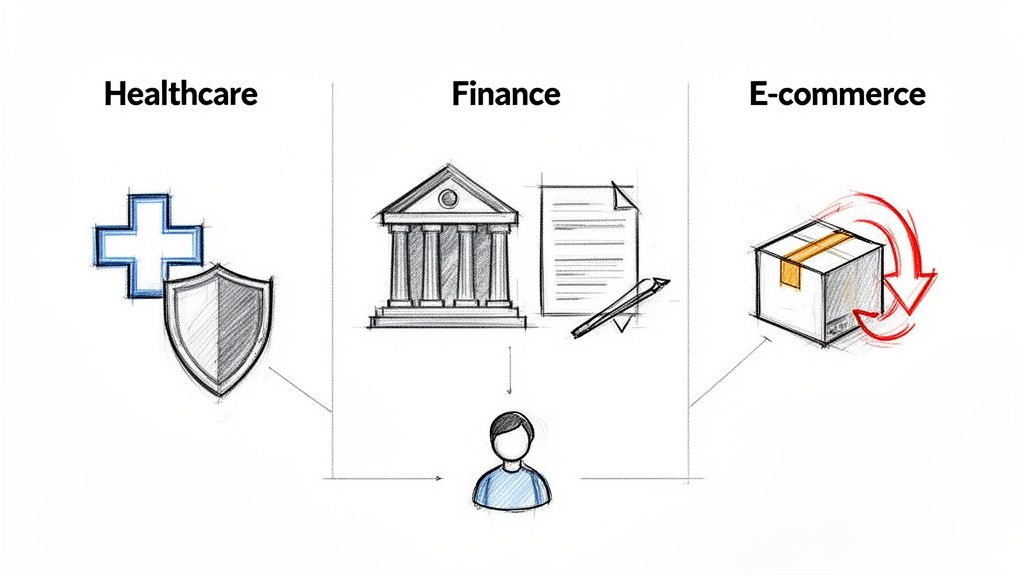
Theory is one thing, but real-time agent assistance truly shines when it’s solving specific, high-stakes problems. The technology’s real value isn't just about general efficiency; it's about delivering measurable results where it matters most. Let's look at how it plays out in three demanding industries: healthcare, finance, and e-commerce.
Healthcare: Navigating Compliance and Empathy
In healthcare, every patient interaction is a tightrope walk between showing empathy and sticking to rigid regulations like HIPAA. One small slip-up can mean massive compliance fines and, even worse, a complete loss of patient trust.
Picture a patient calling their insurance provider. They're confused and anxious about a denied claim, and the agent on the other end needs to help.
- The Challenge: The agent must verify the patient's identity according to HIPAA, find the right plan details, and explain dense insurance jargon—all while sounding calm and supportive.
- The Solution in Action: As the agent listens, the assistance system gets to work. It hears keywords like "claim denial" and "coverage" and instantly puts a HIPAA-compliant identity verification script on the agent's screen. As the call goes on, it pulls up the exact policy clause behind the denial and suggests simple, easy-to-understand ways to explain it.
- The Outcome: The agent walks the patient through the appeals process with confidence, never needing to put them on hold to find a supervisor. The call is handled quickly, compliance is a non-issue, and the patient feels genuinely heard.
Finance: Ensuring Accuracy in High-Stakes Transactions
The entire financial services industry is built on two things: accuracy and trust. When customers are on the line about loans, investments, or potential fraud, agents are under intense pressure to follow complex procedures perfectly. Real-time agent assistance acts as a critical safety net.
Think about a customer calling to apply for a mortgage. It’s a complicated, multi-step ordeal where one missed detail can delay or even kill the entire application.
Real-time assistance turns this into a guided experience. It gives agents a dynamic, on-screen checklist that updates as the conversation unfolds.
As the agent gathers information, the system confirms the data is valid and prompts them for the next required document or disclosure. This simple step virtually eliminates human error. It also listens for opportunities. If the customer mentions "saving for college," the system might pop up a suggestion about opening a 529 plan, turning a routine service call into a new business opportunity.
E-commerce: Delivering Instant Gratification
In the fast-moving world of e-commerce, customer patience is measured in seconds. Shoppers want immediate answers about products, order status, or returns. An agent scrambling for information is the fastest way to lose a sale and earn a one-star review.
Imagine a customer who just got a damaged product and is, justifiably, upset. Their loyalty hangs on how fast and painlessly the agent can fix the problem.
Real-Time Agent Assistance in Action:
| Customer Statement | Agent's Screen Instantly Shows... | Result |
|---|---|---|
| "My package arrived, and the item is broken." | The customer's complete order history and the company's return policy for damaged goods. | The agent doesn't waste time asking for an order number. |
| "I want to exchange it for a new one." | A step-by-step workflow for processing an exchange, including how to generate a return label. | A complicated task becomes a simple, guided process. |
| "This is so frustrating!" | A sentiment alert (Negative) and a suggested empathy statement like, "I completely understand this is disappointing." | The agent has the tools to de-escalate the situation effectively. |
By giving agents the right information at the exact moment they need it, the system lets them solve problems on the first try. This doesn't just save a sale—it transforms a negative experience into a positive one, building the kind of customer loyalty that keeps people coming back. These examples make it clear: real-time agent assistance isn't a generic tool, it's a flexible platform that drives targeted value where the stakes are highest.
Choosing the Right Real Time Agent Assistance Solution
Picking the right real-time agent assistance partner is a huge decision—one that will define your customer service operations for years. The market is packed, and it's all too easy to get bogged down by flashy demos and endless feature lists. What you really need is a clear-eyed evaluation process to find a platform that actually solves your problems and delivers real value.
This checklist is designed to cut through the noise. It’ll guide you toward a solution that truly empowers your agents and gives you a solid return on your investment.
The Foundation: Transcription Accuracy
Everything—and I mean everything—in an agent assistance system depends on one thing: real-time transcription. If the platform can't accurately hear what’s being said, every other feature, from sentiment analysis to automated suggestions, becomes completely useless.
Don't just take a vendor's word on their accuracy stats. You have to put it to the test with your own audio.
Here are the questions you should be asking:
- How do you handle noisy backgrounds and different accents? A contact center is never a pristine recording studio. The system has to work in the real world.
- Can we test the platform with our own call recordings? Give them your toughest files—the ones with industry jargon, people talking over each other, and terrible connection quality.
- What's your transcription latency? For a "real-time" prompt to be useful, the transcription needs to show up almost instantly. Anything over 300 milliseconds is too slow.
Integration and Customization Capabilities
Your agent assistance tool can't live on an island. It has to plug directly into the tools you already use every day, like your CRM, knowledge base, and phone system. A clunky integration process can stall your project for months, wiping out any potential gains before you even start.
Flexibility is just as critical. Your business isn't a generic template; you have unique products, terms, and workflows. You need a Customizable AI Assistant that bends to your needs, not one that forces your team to change how they work.
A powerful platform should adapt to your workflow, not the other way around. Look for robust APIs and pre-built connectors that make integration straightforward and scalable.
Deployment Models: On-Premise vs. Cloud
Finally, you’ll need to decide where the software will live. This choice boils down to a classic trade-off between control, cost, and who handles the maintenance.
Here’s a straightforward comparison of the two main deployment models for real-time agent assistance. This table will help you figure out which path makes the most sense for your organization’s security needs, budget, and IT resources.
On-Premise vs Cloud Deployment Comparison
| Factor | On-Premise Deployment | Cloud-Based (SaaS) Deployment |
|---|---|---|
| Control & Security | Gives you total control over your data and security. This is often a must-have for highly regulated industries. | Security is managed by the vendor. Check for key certifications like SOC 2, ISO 27001, and GDPR compliance. |
| Cost Structure | A big upfront investment (CapEx) for hardware and licenses, plus ongoing costs for maintenance. | A predictable subscription fee (OpEx), billed monthly or annually. |
| Maintenance | Your IT team is on the hook for all updates, security patches, and system upkeep. | The vendor takes care of all maintenance, updates, and infrastructure management behind the scenes. |
| Scalability | To scale up, you have to buy and set up more hardware, which is slow and expensive. | You can easily scale up or down as needed, paying only for the capacity you use. |
For most companies, a cloud-based Software as a Service (SaaS) model hits the sweet spot, offering a great mix of power, scalability, and predictable costs. But if your business operates under strict data sovereignty rules, an on-premise solution might be the only way to go. It's why some providers, like Vatis Tech, offer both deployment options to fit different security and operational requirements.
Answering Your Key Questions
As you get closer to a decision, a few practical questions always come up. It's smart to think through the real-world impact of bringing real time agent assistance into your contact center. Let's tackle the most common ones we hear from leaders, so you can move forward with total clarity.
How Long Does It Take to Implement a Real-Time Platform?
This is probably the first thing on your mind, and the answer is likely faster than you think. Forget about those massive, year-long IT overhauls. Modern, cloud-based platforms are built for speed, and a typical rollout takes anywhere from a few weeks to a couple of months.
Here’s a practical, step-by-step timeline:
- Initial Setup and Integration (1-2 weeks): This is where we connect the platform to your core systems, like your CRM and phone service. Thanks to pre-built connectors, this part is surprisingly fast.
- Knowledge Ingestion and AI Training (1-3 weeks): The AI gets to work learning your business. It digests your knowledge base, product guides, and past call data, fine-tuning itself to understand your specific terminology and customer needs.
- Pilot Program (2-4 weeks): Before going live everywhere, we'll test the system with a small group of agents. This is our chance to fine-tune the on-screen prompts and get direct feedback to make sure everything is running perfectly.
- Full Rollout and Training (1-2 weeks): With a successful pilot complete, the platform is rolled out to the whole team. We’ll also run training sessions to get everyone comfortable with their new AI “co-pilot.”
From start to finish, you’re often looking at less than a single business quarter. That means you can start seeing a return on your investment almost immediately.
Will My Agents Feel Like They Are Being Spied On?
This is a huge, and completely valid, concern. Getting your agents on board is non-negotiable, and the key is to frame real time agent assistance as a support tool, not a surveillance one. Think of it as a safety net designed to make their jobs easier, not a tool for micromanagement.
The best way to get buy-in is to show them what’s in it for them:
- Less Stress: The AI remembers all the complex compliance scripts and obscure product details so they don’t have to.
- More Confidence: New hires can handle tough calls like a seasoned pro from day one.
- Faster Resolutions: They can solve customer issues on the first try, which feels great and boosts job satisfaction.
Position the tool as a personal coach or an expert partner that’s always there to help. When agents see the system helping them hit their targets and reduce customer frustration, they quickly move from skepticism to advocacy.
Transparency is also your best friend here. Show them exactly how the tool works and where the suggestions come from. Once they understand it’s there to help them win, adoption becomes a non-issue.
Can Real Time Assistance Handle Multiple Languages and Complex Accents?
Absolutely. For any global support team, this is a must-have. The engine driving any great agent assistance platform is its Speech-to-Text (STT) technology, and today's STT is incredibly powerful.
Top-tier solutions can accurately transcribe dozens of languages and dialects in real time. These systems are trained on massive datasets of real-world conversations, which gives them the ability to handle:
- A huge range of accents, like distinguishing between different regional English accents.
- Industry-specific jargon and unique product names.
- Poor audio quality from bad cell connections or noisy call environments.
For instance, a system like Vatis Tech can process over 50 languages. This means your agent in Madrid gets real-time guidance in Spanish, while another in Manila gets help in Tagalog—all running on the same platform. The technology makes language a bridge to great service, not a barrier.
What Kind of ROI Can We Realistically Expect in the First Year?
The return on investment (ROI) from real-time agent assistance is both fast and comes from multiple directions. You can expect to see real, measurable improvements in your most important metrics within the first six to twelve months.
Let's break down where you'll see the returns:
| Area of Impact | Expected Improvement (First Year) | How It Drives ROI |
|---|---|---|
| Operational Efficiency | 15-25% reduction in Average Handle Time (AHT). | You lower your cost-per-call and give your team more capacity without adding headcount. |
| Customer Experience | 10-20% increase in First Call Resolution (FCR). | Fewer frustrated customers calling back means less churn, which directly protects your revenue. |
| Agent Performance | Up to a 50% reduction in new hire onboarding time. | Agents become productive faster, which cuts training costs and helps reduce agent turnover. |
A very realistic goal for the first year is to achieve a positive ROI where the savings from new efficiencies and the revenue you save from higher customer retention more than cover the platform's cost. The trick is to benchmark your current metrics before you start, so you can clearly track the uplift.
Ready to see how an AI co-pilot can transform your contact center? Vatis Tech provides highly accurate, real-time transcription and agent assistance that empowers your team, improves customer satisfaction, and delivers a clear return on investment.
Explore our advanced Speech-to-Text solutions today and discover how to make every agent your best agent.