
TABLE OF CONTENTS
Experience the Future of Speech Recognition Today
Try Vatis now, no credit card required.
In an era where customer experience defines brand loyalty, a reactive, sample-based quality assurance program is no longer enough. Customers expect seamless, empathetic, and effective interactions every time, and your QA process is the engine that drives this consistency. However, many contact centers still rely on outdated methods: manually reviewing a tiny fraction of calls, using simplistic scorecards, and delivering feedback days or weeks after the fact.
This approach leaves massive blind spots, fails to capture the true customer experience, and struggles to keep pace with omnichannel communication. It treats quality as a historical audit rather than a real-time performance driver. Moving beyond these legacy constraints is not just an operational improvement; it's a strategic necessity for retaining customers and building a resilient brand. For a deeper dive into overall strategies for modernizing your operations, explore the Top 10 Call Center Management Best Practices for 2026.
This comprehensive guide outlines 10 modern contact center quality assurance best practices designed to turn your QA from a compliance checkbox into a strategic growth driver. We will explore how to build a data-rich, AI-powered, and agent-centric quality ecosystem that not only meets but exceeds current demands.
You will learn how to:
- Implement multi-dimensional scoring and AI-assisted evaluations.
- Integrate customer feedback directly into QA workflows.
- Establish agent-centric coaching programs that drive real improvement.
By embracing these strategies with practical examples and steps for implementation, you can foster a culture of continuous improvement and ensure every customer interaction reflects the best of your brand.
1. Implement Multi-Dimensional Scoring Systems
Moving away from a single, monolithic quality score is one of the most impactful contact center quality assurance best practices you can adopt. Instead, a multi-dimensional scoring system evaluates interactions across several distinct criteria. This approach recognizes that a customer interaction is a complex event with many facets, including accuracy, compliance, efficiency, and the customer's emotional journey. By breaking down the evaluation, you gain a granular, holistic view that pinpoints specific strengths and weaknesses.
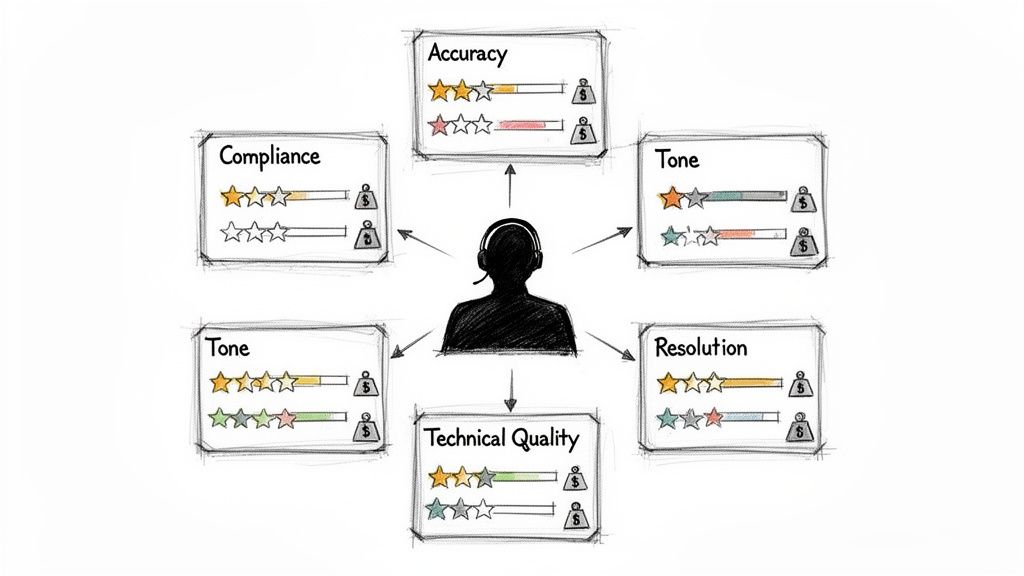
This method replaces a simple pass/fail or a single percentage with a detailed profile. For instance, an agent might excel in empathy and building rapport but struggle with adhering to a specific compliance script. A single score would obscure this detail, whereas a multi-dimensional scorecard makes it immediately obvious where coaching is needed.
How to Implement Multi-Dimensional Scoring
A successful rollout requires careful planning and alignment with your business objectives. Follow these practical steps:
- Step 1: Define Your Dimensions: Start by identifying 4-6 key dimensions that matter most to your business and customers. Common categories include Compliance & Security, Procedural Accuracy, Customer Experience (e.g., empathy, tone), and Resolution (e.g., First Contact Resolution).
- Step 2: Assign Weights: Not all dimensions are created equal. For a financial services contact center, a question about regulatory compliance might carry a much heavier weight than a question about call opening pleasantries. Assign percentage weights to each dimension to reflect its importance. For example, Compliance might be 40%, while Customer Experience is 25%.
- Step 3: Use Complete Data: To score accurately across multiple dimensions, you need a full record of the interaction. Advanced transcription tools, like Vatis Tech, can provide a complete and accurate text transcript. This allows reviewers to analyze the conversation for specific keywords, sentiment, and adherence to complex procedures without having to listen to audio repeatedly.
- Step 4: Train Your Evaluators: Consistency is critical. Conduct extensive calibration sessions with your QA team to ensure every evaluator understands and applies the scoring criteria for each dimension uniformly.
Practical Example: A retail e-commerce company can use a multi-dimensional scorecard to evaluate an agent handling a return request. The scorecard might look like this:
| Dimension | Weight | Agent Score | Details |
|---|---|---|---|
| Procedural Accuracy | 35% | 100% | Agent correctly located the order, verified the return policy, and processed the RMA without error. |
| Customer Experience | 30% | 80% | Agent showed empathy for the customer's issue but used a slightly rushed tone toward the end. |
| Resolution | 25% | 100% | The return was fully processed on the first call, and the customer received a confirmation email. |
| Compliance | 10% | 100% | Agent provided the required disclosure about restocking fees. |
| Overall Score | 94.5% |
This detailed breakdown shows the exact area (tone) that needs minor coaching, rather than just a generic high score.
2. Establish Calibration Sessions and Quality Standards
One of the cornerstones of a successful program is ensuring that every quality evaluation is consistent, fair, and objective. Establishing regular calibration sessions is a fundamental contact center quality assurance best practice that standardizes how your team defines and measures quality. These structured meetings bring evaluators together to score the same interaction, compare results, and align on scoring rationale, effectively eliminating subjective differences.
Without calibration, two evaluators could give wildly different scores for the same agent performance, leading to agent frustration and skewed performance data. Calibration creates a unified understanding of your quality scorecard, ensuring that an agent in Team A is graded by the exact same standards as an agent in Team B. This process is critical for maintaining the integrity and credibility of your entire QA program.
How to Implement Calibration Sessions
Effective calibration is a disciplined, repeatable process, not an informal chat. Follow these steps to build a robust system for consistency:
- Step 1: Schedule Regularly: Hold sessions at a consistent cadence, such as weekly or bi-weekly. This frequency keeps standards top-of-mind and allows you to address any scoring drift before it becomes a major issue.
- Step 2: Set an Agreement Target: Your goal is to achieve high Inter-Rater Reliability (IRR). Aim for a target agreement of at least 85-90% among evaluators to ensure evaluations are dependable across the board.
- Step 3: Use Accurate Transcripts: Base your calibrations on objective data. Complete and accurate transcripts from services like Vatis Tech provide an unbiased record of the conversation. This allows evaluators to pinpoint exact phrasing and procedural steps without the ambiguity of re-listening to audio, making it easier to justify a score.
- Step 4: Document Everything: During the session, document the final agreed-upon score for each criterion and the detailed rationale behind it. This documentation becomes a living guide for future evaluations and helps onboard new QA team members.
- Step 5: Review and Refine: Use insights from calibration meetings to identify ambiguous or outdated items on your scorecard. These sessions are a perfect opportunity to refine your quality standards on a quarterly basis based on emerging trends or new business requirements.
Practical Example: A healthcare provider standardizes how reviewers score interactions for clinical accuracy. During a calibration session, five QA specialists review a transcribed call where a patient describes symptoms. One evaluator scores "Active Listening" at 8/10, while another scores it 5/10. The team lead facilitates a discussion: the first evaluator noted the agent repeated the symptoms back, but the second pointed out the agent interrupted the patient twice. The team agrees that interruptions are a critical failure in active listening and aligns on a final score of 6/10, documenting that "interrupting the patient while they describe their condition automatically lowers the active listening score." This documented rule now ensures future consistency.
3. Leverage Real-Time Quality Monitoring and Feedback
Shifting quality assurance from a purely historical review to an in-the-moment activity is a game-changer. Real-time quality monitoring involves using technology to analyze interactions as they happen, enabling supervisors to provide immediate coaching or intervention. This proactive approach contrasts sharply with traditional post-interaction analysis, maximizing the learning impact by addressing issues during or directly after a call, improving customer outcomes instantly.
This method allows for immediate course correction. For instance, a supervisor can discreetly message an agent with a suggestion if they notice the agent is struggling with a complex customer query or is about to miss a critical compliance step. This not only saves the interaction but also provides a powerful, contextual learning opportunity that is far more effective than a review session days later.
How to Implement Real-Time Quality Monitoring
A successful real-time program requires a balance of technology, training, and transparency. Follow these practical steps to get started:
- Step 1: Set Clear Intervention Criteria: Define exactly when a supervisor should intervene. This could be triggered by specific keywords indicating customer frustration (e.g., "complaint," "unhappy," "manager"), missed compliance phrases, or extended periods of silence.
- Step 2: Train for Developmental Coaching: Supervisors must be trained to provide non-punitive, developmental in-call coaching. The goal is to support the agent, not to discipline them in front of a customer. Role-playing scenarios are excellent for this type of training.
- Step 3: Maintain Transparency: Agents should be fully aware of how and when they are being monitored. A transparent policy builds trust and encourages agents to see real-time monitoring as a supportive tool rather than a punitive "gotcha" system.
- Step 4: Review Coaching Moments: Use complete interaction records to analyze the effectiveness of real-time interventions. Accurate transcripts from services like Vatis Tech are invaluable here, as they allow supervisors and agents to review the exact phrasing and context of a coaching moment. You can discover how audio intelligence supports this process by providing searchable text from every call.
Practical Example: A financial services firm monitors calls for specific compliance keywords in real-time. The system detects that a customer has said "I want to close my account," but the agent has not yet mentioned the required "retention offer disclosure." The system alerts the supervisor, who sends a private message to the agent's screen: "Reminder: Offer the 3-month fee waiver before proceeding with closure." The agent sees the prompt, delivers the disclosure, and successfully retains the customer, preventing a compliance breach and customer churn in one action.
4. Deploy AI-Assisted and Automated Quality Evaluation
Manually reviewing a small sample of interactions means that critical insights from the other 95-99% of conversations are lost. Implementing AI-assisted and automated quality evaluation is a powerful contact center quality assurance best practice that allows you to analyze 100% of your interactions at scale. This technology automatically scores conversations against defined criteria, identifies trends, and flags high-risk or exceptional calls for human review.
This approach doesn't replace human evaluators but rather supercharges their efforts. AI handles the repetitive, large-scale analysis, freeing up your QA specialists to focus on nuanced coaching, complex judgment calls, and strategic program improvements. It shifts the QA function from a reactive, sample-based audit to a proactive, comprehensive performance management engine.
How to Implement AI-Assisted Quality Evaluation
A successful deployment integrates AI into your existing workflows to add value without creating friction. Follow these practical steps to get started:
- Step 1: Start with Clear Metrics: Begin by automating the evaluation of easily definable, objective criteria. This includes flagging specific compliance keywords (e.g., "this call is recorded"), measuring script adherence, and detecting negative sentiment that might indicate customer dissatisfaction. You can learn more about how sentiment detection works by reviewing the ultimate guide to speech-to-text sentiment analysis APIs.
- Step 2: Prioritize High-Quality Transcription: AI evaluation is only as good as the data it analyzes. A high-accuracy transcription service is essential. For instance, Vatis Tech’s 98%+ accuracy ensures the AI model has clean, reliable data to work from, dramatically improving the precision of its automated scoring and analysis.
- Step 3: Maintain a Human-in-the-Loop: Use AI to flag interactions, but keep a human review layer to validate the AI's findings. This is crucial for handling context-dependent scenarios and ensuring fairness. This validation process also helps you continuously refine and improve your AI models.
- Step 4: Make it Explainable: For agent buy-in, the AI's decisions must be transparent. Implement systems that show agents why an interaction was flagged. For example, the system should highlight the specific phrases that triggered a low sentiment score or the part of the call where a required compliance statement was missed.
Practical Example: An insurance company uses AI to scan 100% of its claims calls. The AI automatically scores each call on whether the agent used the required empathetic statement ("I'm sorry to hear you've been in an accident") and whether they provided the correct claim number format. Any call where the customer's sentiment drops sharply or where the agent doesn't follow the script is automatically flagged and sent to a human QA specialist for in-depth review and coaching. This ensures all high-risk calls are caught without manual effort.
5. Implement Comprehensive Recording and Transcription Standards
A foundational element of any robust quality program is the ability to capture every customer interaction completely and accurately. Implementing standards for comprehensive recording and transcription moves QA from a subjective, sample-based activity to a data-driven, searchable discipline. This practice creates an auditable record of every call, chat, and email, which is invaluable for quality analysis, compliance checks, agent training, and resolving customer disputes.

Without a full transcript, reviewers rely on memory and manual spot-checking, which is inefficient and prone to error. A complete text record allows evaluators to search for specific keywords, analyze conversation flow, and verify adherence to complex procedures with precision. This makes the entire QA process more efficient and objective, forming the bedrock of modern contact center quality assurance best practices.
How to Implement Recording and Transcription Standards
Creating a reliable interaction database requires clear policies and the right technology. Follow these steps to build a solid foundation:
- Step 1: Set Clear Technical Standards: Define your requirements for recording and transcription. This should include targets for transcription accuracy (e.g., 95% or higher), required turnaround times, and mandatory speaker identification (diarization).
- Step 2: Automate Transcription: Manual transcription is not scalable. Use an automated speech-to-text solution like Vatis Tech, which supports over 50 languages, to create searchable transcripts automatically. This enables global contact centers to maintain consistent quality standards across all regions. You can learn more about speech-to-text for call centers and how it can be applied.
- Step 3: Establish Retention and Audit Policies: Create clear data retention schedules that align with business needs and regulatory mandates (e.g., GDPR, HIPAA). Plan to audit a sample of transcripts (at least 5-10%) against the source audio regularly to verify accuracy.
- Step 4: Ensure Security and Compliance: Transcripts often contain personally identifiable information (PII). Implement automatic PII redaction to protect sensitive data during storage and review, ensuring compliance and customer privacy.
Practical Example: A telecommunications company is facing disputes from customers claiming they never agreed to a contract extension. By implementing 100% recording and transcription, the support team can resolve disputes in minutes. When a customer calls to complain, the manager searches the transcript database for the customer's phone number, finds the exact call, and can instantly confirm whether the agent secured verbal consent by searching for the phrase "I agree to the terms." This searchable, objective proof resolves the dispute immediately and provides a clear record for legal purposes.
6. Establish Agent-Centric Coaching and Development Programs
Effective quality assurance doesn't stop at scoring; its true value is realized through coaching that fosters agent growth. An agent-centric approach transforms QA from a punitive process into a developmental one. Instead of simply pointing out errors, this best practice uses quality data to create personalized, ongoing coaching relationships between supervisors and agents, focusing on skill development rather than just compliance.
This method moves away from generic, one-size-fits-all training and toward targeted improvement plans with measurable outcomes. For example, TD Bank's coaching methodology prioritizes agent skill-building over penalizing minor infractions, creating a supportive environment. Similarly, Zappos is famous for its customer service training, which centers on agent empowerment and continuous personal development, leading to their legendary customer experience.
How to Implement Agent-Centric Coaching
Building a successful coaching program requires a shift in mindset from enforcement to empowerment. Here are practical steps to make it happen:
- Step 1: Focus on 1-2 Key Areas: Avoid overwhelming agents with a long list of critiques. Concentrate each coaching session on one or two specific, high-impact behaviors. This focused approach makes feedback more manageable and actionable.
- Step 2: Use Concrete Examples: Vague feedback is ineffective. Use timestamped examples from interaction transcripts to show agents exactly where a behavior occurred. With a tool like Vatis Tech, you can highlight specific phrases in the transcript, making it easy for agents to review the context and understand the coaching point.
- Step 3: Track Coaching Effectiveness: Measure the impact of your efforts through longitudinal quality trend analysis. Track an agent’s performance on coached behaviors over time to see if the training is sticking and to justify the investment in your program.
- Step 4: Celebrate Improvement: Acknowledgment is a powerful motivator. Visibly celebrate improvements by comparing an agent’s current performance to their previous baselines. Tying quality improvements to recognition, incentives, or advancement opportunities reinforces positive behaviors.
Practical Example: A QA review finds that Agent Alex struggles with expressing empathy. Instead of just telling him to "be more empathetic," his manager uses a transcript from a difficult call. He highlights the moment where the customer said, "I'm so frustrated," and Alex responded with, "Okay, what's your account number?" The manager then shows Alex a transcript from a top-performing agent who, in a similar situation, said, "I can absolutely understand your frustration; let's get this sorted out for you." They role-play the better response. For the next two weeks, the manager's coaching focuses only on this one skill, tracking its improvement until it becomes natural for Alex.
7. Conduct Regular Quality Audits and Compliance Reviews
A quality assurance program is only effective if the program itself is held to a high standard. Implementing systematic, scheduled audits of your QA processes ensures the entire function operates as intended. These internal and external audits go beyond evaluating individual agent interactions; they scrutinize the evaluators, the scorecards, and the overall adherence to both internal standards and external regulations. Regular audits verify that QA standards are applied consistently and that critical compliance requirements are being met across the board.
This practice is essential for maintaining objectivity and effectiveness in your QA efforts. It prevents "evaluator drift," where different QA specialists begin interpreting scoring criteria differently over time. For industries with strict regulatory oversight, like healthcare or finance, these audits are not just a best practice-they are a requirement for maintaining licensure and avoiding severe penalties.
How to Implement Regular Audits
Building a robust audit process requires a structured approach and a commitment to continuous improvement. Follow these steps to establish a successful audit and compliance review cycle:
- Step 1: Establish an Audit Calendar: Create an annual calendar that clearly outlines the schedule, scope, and objectives for each audit. Specify whether the audit is internal (reviewing QA consistency) or external (verifying regulatory compliance like HIPAA or SOC 2).
- Step 2: Use Complete Interaction Data: To verify compliance accurately, auditors need a full, searchable record. Using advanced transcription from tools like Vatis Tech, which holds ISO 27001 certification, provides auditors with precise text transcripts. This allows them to quickly search for required disclosures, PII handling keywords, and adherence to specific scripts.
- Step 3: Document and Remediate: Document all audit findings, assign severity levels, and establish clear remediation timelines. Create executive dashboards to show compliance trends and highlight areas needing immediate attention. The goal is not to punish but to identify and fix systemic weaknesses.
- Step 4: Update Standards and Training: Use the findings from your audits to refine QA scorecards, update training materials, and improve agent coaching. To help agents excel and consistently meet these updated quality standards, consider these Call Handling Best Practices that outline effective communication strategies and service delivery.
Practical Example: A healthcare contact center conducts a quarterly internal HIPAA compliance audit. The auditor randomly selects 50 transcribed calls and searches for any instance where an agent might have shared Protected Health Information (PHI) with an unverified caller. The search flags two calls where agents did not complete the full two-step identity verification process before discussing test results. The audit report recommends immediate retraining for the entire team on the verification script and a change to the QA scorecard to make identity verification a "critical, auto-fail" item if missed.
8. Implement Customer Feedback Integration into QA Processes
Your internal quality metrics are only valuable if they reflect what customers actually care about. Integrating direct customer feedback into your QA process creates a powerful validation loop, ensuring that what you measure internally genuinely predicts and influences customer satisfaction. This practice moves quality assurance from a purely operational function to a strategic driver of customer loyalty and business outcomes.
This approach systematically connects quality scores with feedback from surveys, ratings, and direct complaints. For example, by correlating Net Promoter Score (NPS) with specific dimensions on your quality scorecard, you can discover that "First Contact Resolution" has a much stronger impact on customer loyalty than "Adherence to Call Opening Script." This insight allows you to adjust your quality standards and agent training to focus on what truly matters to customers.
How to Implement Customer Feedback Integration
A successful integration requires a systematic process for collecting, correlating, and acting on combined data. Follow these practical steps:
- Step 1: Correlate Data Promptly: To establish a clear link, collect customer feedback within 24-48 hours of an interaction. The closer the survey is to the experience, the more accurate the correlation between the customer’s perception and the agent's performance will be.
- Step 2: Analyze the Extremes: Focus your analysis on feedback from the most and least satisfied customers (e.g., NPS Detractors vs. Promoters). Examine the associated quality evaluations for these interactions to identify patterns. What do your highest-scoring agents do differently on interactions that result in a high CSAT score?
- Step 3: Use Predictive Analytics: Advanced tools can analyze the sentiment of a conversation as it happens. For example, Vatis Tech’s sentiment analysis can predict a customer’s satisfaction level based on their word choice and tone. You can then validate these predictions with post-call surveys, refining your ability to identify at-risk interactions in real-time.
- Step 4: Close the Loop with Agents: Don't just show agents a score; share the customer’s verbatim feedback alongside their quality evaluation. Hearing the customer’s words provides powerful context and motivation, making coaching more impactful and personal. This is a key part of building a customer-centric culture.
Practical Example: A major airline correlates post-call NPS surveys with its internal QA scores. They find a surprising trend: some calls that receive a high internal QA score (e.g., 95%) still result in a low NPS score (Detractor). By analyzing the transcripts and customer comments for these calls, they discover that while agents were following the script perfectly, they were not effectively explaining complex baggage fee policies. This direct link justifies deprioritizing "script adherence" on the scorecard and adding a new, heavily-weighted section on "clarity of explanation," leading to measurable improvements in customer satisfaction.
9. Establish Quality Metrics and Key Performance Indicators (KPIs)
Defining clear, measurable quality metrics and Key Performance Indicators (KPIs) is a foundational contact center quality assurance best practice. These metrics are the compass for your QA program, guiding decisions and providing a shared language for performance. Well-designed KPIs align your quality efforts with broader business objectives, regulatory requirements, and customer expectations, creating accountability and offering clear visibility into what success looks like.
These indicators move quality assurance from a subjective exercise to a data-driven function. Instead of simply saying "an agent did a good job," you can point to specific achievements like a 98% procedural accuracy score, a 5-point increase in Customer Satisfaction (CSAT), or a 10% reduction in repeat calls. This creates a direct link between agent behavior and business outcomes.
How to Establish Quality Metrics and KPIs
Building a meaningful KPI framework requires a strategic approach that connects daily activities to high-level goals. Use these steps to create metrics that drive performance:
- Step 1: Align with Business Strategy: Start by asking what your business is trying to achieve. Is the goal to increase customer loyalty, reduce operational costs, or minimize compliance risk? Your KPIs must directly reflect these objectives.
- Step 2: Keep Your Core Set Small: Avoid overwhelming your team with dozens of metrics. Focus on a core set of 5-7 key KPIs that provide a balanced view of performance. A common framework includes a mix of efficiency, effectiveness, and experience metrics.
- Step 3: Use High-Fidelity Data: The accuracy of your KPIs depends on the quality of your data. Using high-accuracy transcription tools like Vatis Tech to analyze interactions provides the clean, reliable data needed to measure KPIs like script adherence, specific phrase usage, or the accurate capture of customer information. This solid data foundation prevents disputes over metric calculations.
- Step 4: Set Clear Benchmarks: A metric without a target is just a number. Establish clear benchmarks and realistic improvement goals with specific timelines. Review and validate these targets quarterly to ensure they remain relevant and challenging, but achievable.
Practical Example: A company focused on operational efficiency wants to reduce costs. Their KPI framework would prioritize:
| KPI | Description | Business Goal |
|---|---|---|
| First Contact Resolution (FCR) | Percentage of issues resolved in a single interaction. | Reduce repeat calls and operational costs. |
| Average Handle Time (AHT) | Average time spent on each interaction. | Increase agent capacity and efficiency. |
| Adherence to Automation Script | Percentage of calls where agent correctly guides user to self-service. | Deflect simple inquiries from live agents. |
| Customer Satisfaction (CSAT) | Post-call survey measuring customer satisfaction. | Ensure efficiency doesn't negatively impact customer experience. |
This balanced set ensures that while the team is focused on being faster (AHT), they are also focused on being effective (FCR) and keeping customers happy (CSAT).
10. Develop Comprehensive Quality Documentation and Training Materials
A robust QA program is built on a foundation of clear, consistent, and accessible information. Developing comprehensive documentation for your quality standards, evaluation guidelines, and procedures is a critical contact center quality assurance best practice. This creates a single source of truth that removes ambiguity, standardizes agent performance, and streamlines the onboarding process for new QA specialists and agents alike.
Without well-documented standards, quality becomes subjective, leading to inconsistent evaluations and agent frustration. Detailed materials ensure that every stakeholder, from the frontline agent to the QA manager, understands what "good" looks like and how it is measured. This clarity is essential for building trust in the QA process and driving meaningful performance improvements. For example, legal firms create strict documentation for attorney-client call handling to ensure every interaction meets compliance and confidentiality standards.
How to Implement Comprehensive Documentation
Effective documentation is more than just a manual; it's a living resource that guides daily operations. Follow these steps to build and maintain your quality library:
- Step 1: Create Tiered Resources: Not everyone needs the same level of detail. Structure your documentation in tiers: Quick Reference Guides for agents (e.g., call opening/closing scripts), Detailed Procedural Manuals for supervisors and QA evaluators (e.g., step-by-step scoring instructions), and Advanced Scenario Libraries for complex or edge-case interactions.
- Step 2: Use Real-World Examples: Abstract rules are hard to apply. Use real, anonymized interaction transcripts from a tool like Vatis Tech as teaching aids. Annotate these transcripts to show exactly why an interaction received a certain score, highlighting both exemplary moments and areas for improvement.
- Step 3: Establish Version Control: Quality standards evolve. Implement a version control system to track changes, document the reason for updates (e.g., new compliance rules, findings from calibration), and communicate updates to all relevant staff. A simple best practice is to review and update all documentation quarterly.
- Step 4: Gather Continuous Feedback: Your documentation is only useful if people use it. Regularly solicit feedback from agents, team leads, and the QA team on the clarity, accessibility, and usefulness of the materials. Use this input to make practical improvements.
Practical Example: A software company creates a "Scenario Library" for its technical support agents. For the common issue of "password reset failure," the library contains:
- A quick reference guide with the 3 most common solutions.
- A detailed step-by-step guide with screenshots for complex backend reset procedures.
- An annotated transcript of an "exemplary call" where a top agent calmed a frustrated user and successfully resolved the issue, with callouts explaining the techniques used.
- An annotated transcript of a "poor call" where the agent failed to resolve the issue, with notes on what went wrong and how it could have been handled better.
This library serves as a powerful self-service training tool for both new and veteran agents.
Top 10 Contact Center QA Best Practices Comparison
| Initiative | Implementation complexity | Resource requirements | Expected outcomes | Ideal use cases | Key advantages |
|---|---|---|---|---|---|
| Implement Multi-Dimensional Scoring Systems | High — design dimensions, weights, dashboards | QA analysts, configurable tools, training, reliable transcripts | Holistic insights across quality facets; targeted improvement plans | Complex operations with varied objectives (healthcare, large contact centers) | Identifies specific gaps; reduces subjectivity; aligns QA with business goals |
| Establish Calibration Sessions and Quality Standards | Medium — scheduling, guideline development | QA team time, sample recordings, scoring tools, IRR measurement | Greater scorer consistency; documented standards; fewer disputes | Multi-site or growing QA teams needing evaluator alignment | Improves fairness; speeds onboarding; preserves scoring consistency |
| Leverage Real-Time Quality Monitoring and Feedback | High — live integration and alerting | Real-time transcription, monitoring platform, trained supervisors | Immediate interventions; faster agent improvement; compliance mitigation | High-risk or compliance-sensitive interactions; live escalation needs | Enables in-the-moment coaching; prevents issues before escalation |
| Deploy AI-Assisted and Automated Quality Evaluation | High — AI/ML models, tuning, integration | AI expertise, compute, high-quality transcripts, continuous maintenance | 100% interaction coverage, pattern detection, reduced manual workload | Large-volume centers, trend detection, enterprise compliance monitoring | Scales QA coverage; consistent baseline scoring; rapid issue detection |
| Implement Comprehensive Recording and Transcription Standards | Medium–High — policy, storage, security | Recording infrastructure, transcription service, storage, access controls | Searchable, auditable records; foundation for QA, training, disputes | Regulated industries, litigation-prone environments, global centers | Verifiable records; supports audits, training, and full QA analysis |
| Establish Agent-Centric Coaching and Development Programs | Medium — program design and ongoing support | Supervisor time, coaching materials, transcript examples, tracking | Improved agent skills, engagement, retention; measurable progress | Organizations focused on agent development and retention | Personalized growth; shifts culture to developmental feedback |
| Conduct Regular Quality Audits and Compliance Reviews | Medium–High — audit frameworks and expertise | Audit specialists, transcripts, compliance tools, documentation | Early gap detection, regulatory assurance, documented remediation | Highly regulated sectors needing periodic verification (healthcare, finance) | Validates QA processes; reduces compliance risk; creates audit trails |
| Implement Customer Feedback Integration into QA Processes | Medium — data integration and analysis | Survey platforms, analytics, data integration, statistical capability | QA metrics validated against customer satisfaction; refined priorities | Customer-centric businesses aiming to tie QA to outcomes | Ensures QA relevance; aligns quality with CSAT/NPS and retention |
| Establish Quality Metrics and Key Performance Indicators (KPIs) | Medium — metric design and governance | Data systems, dashboards, stakeholder alignment, baseline data | Clear performance visibility, accountability, early warnings | Organizations needing standardized performance tracking and reporting | Drives data-driven decisions; enables benchmarking and alerts |
| Develop Comprehensive Quality Documentation and Training Materials | Medium–High — content creation and maintenance | Technical writers, training developers, transcripts, LMS | Consistent application of standards, faster onboarding, referenceable guides | Distributed teams, high-turnover environments, multi-location ops | Preserves institutional knowledge; reduces evaluator variability |
From Theory to Transformation: Activating Your New QA Strategy
We have journeyed through a detailed map of contact center quality assurance best practices, moving from foundational principles to advanced execution. The core message is clear: modern QA is not about catching agents making mistakes. It's a strategic function dedicated to building an exceptional customer experience, empowering agents, and driving measurable business results.
Recapping our key points, we've seen how a successful program is built on a series of interconnected pillars. It begins with a well-defined structure, using multi-dimensional scoring to capture the full spectrum of an interaction, from procedural adherence to the agent's soft skills. This structure is reinforced by consistent calibration sessions, which ensure that every evaluator, from peer reviewers to senior managers, speaks the same quality language.
Synthesizing Strategy into Action
The true power of these practices emerges when they are integrated. Consider the relationship between technology and human insight. Deploying AI-assisted evaluation and real-time monitoring isn't about replacing human analysts. Instead, it’s about augmenting their abilities, allowing them to focus on what matters most: nuanced coaching and strategic trend analysis. AI can automatically flag compliance risks or analyze sentiment across thousands of calls, freeing up your team to conduct the deep-dive, agent-centric coaching sessions that build skills and confidence.
Similarly, integrating customer feedback directly into your QA process closes a critical loop. When an agent's scorecard is reviewed alongside the customer's CSAT or NPS rating for that same interaction, the conversation shifts from theoretical to tangible. This direct line of sight helps agents understand the real-world impact of their words and actions, making quality metrics more meaningful.
Your Roadmap for Implementation
Adopting these contact center quality assurance best practices is a marathon, not a sprint. The goal is to build an agile, intelligent, and human-centered quality ecosystem. Avoid the pitfall of trying to boil the ocean; a gradual, deliberate approach yields the most sustainable results.
Here is a practical starting roadmap:
- Assess and Prioritize: Begin by auditing your current QA program against the ten practices outlined in this article. Identify your most significant gaps. Is it a lack of standardized scoring? Inconsistent coaching? Start there.
- Launch a Pilot Program: Select one or two high-impact practices to implement first. For many, this means redesigning the scorecard (Practice #1) and formalizing calibration (Practice #2). This creates a solid foundation and builds early momentum.
- Invest in Foundational Technology: Recognize that accurate transcription is the bedrock of modern QA. Without a clean, searchable, and speaker-diarized record of conversations, AI-driven analysis, keyword spotting, and even effective manual review become nearly impossible.
- Measure, Iterate, and Expand: Track the impact of your changes on key metrics like First Call Resolution (FCR), Agent Satisfaction (ASAT), and Customer Satisfaction (CSAT). Use this data to justify expanding your efforts into areas like automated monitoring and deeper feedback integration.
By combining a clear strategy with powerful tools and a sincere commitment to agent development, you can elevate your QA program from a simple compliance checker into a powerful engine for customer loyalty, operational efficiency, and sustainable growth. The future of exceptional customer service is built on an unwavering foundation of quality, and you now have the blueprint to construct it.
Ready to build your quality program on a foundation of world-class transcription accuracy? Vatis Tech provides the AI-powered speech-to-text engine that powers modern contact center analytics, turning your customer conversations into structured, actionable data. Explore how our precise transcripts, speaker diarization, and customizable vocabulary can fuel your new QA strategy at Vatis Tech.