
TABLE OF CONTENTS
Experience the Future of Speech Recognition Today
Try Vatis now, no credit card required.
Ever wondered how your phone instantly turns your spoken words into a text message? Or how a video call magically produces live captions in real time? That’s Automatic Speech Recognition (ASR) at work—the foundational technology that converts human speech into written text.
It's the engine behind countless tools we now take for granted, making technology more accessible and efficient.
What Does ASR Mean in Simple Terms?
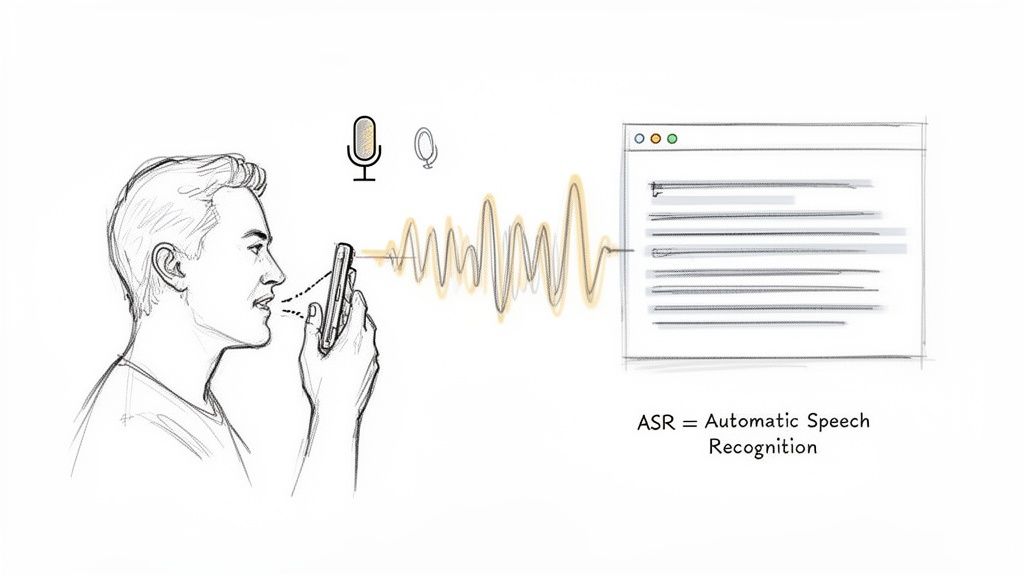
Think of ASR as an incredibly fast digital typist. When you speak, the system “listens,” analyzes the sounds, and converts them into words on a screen, often in just a fraction of a second.
ASR is the fundamental AI capability that allows machines to understand and process human language. It bridges the gap between spoken words and machine-readable data, turning audio into a searchable, editable, and analyzable format.
Without it, voice assistants like Siri and Alexa wouldn't work, and transcribing hours of meetings or interviews would still be a painstakingly manual job.
The Core Idea of ASR
At its heart, ASR is a conversion process. The technology breaks down your speech into tiny, distinct units of sound called phonemes. It then uses sophisticated algorithms and acoustic models to match these sounds to words and assemble them into coherent sentences.
To get a better sense of what ASR is, here's a quick breakdown of its key components.
ASR at a Glance
| Component | Simple Explanation | Practical Example |
|---|---|---|
| Acoustic Model | "Listens" to the audio and matches sounds to phonemes (the building blocks of words). | Hears the sounds "h," "uh," and "l-oh" in the word "hello." |
| Language Model | Predicts the most likely sequence of words to form grammatically correct sentences. | Knows that "write a letter" is more likely than "right a letter." |
| Lexicon (Dictionary) | Contains a vast vocabulary and the phonetic pronunciation of each word. | Stores the word "computer" and its phonetic spelling: /kəmˈpjuːtər/. |
Together, these parts work in harmony to make sense of what you're saying.
You see ASR in action all the time:
- Voice-to-text messaging on your smartphone.
- Dictating notes into a document instead of typing.
- Searching for videos on YouTube with your voice.
- Automated captions that pop up on social media videos.
Ultimately, ASR takes the most natural form of human communication—speech—and makes it something computers can work with. This simple but powerful function drives a huge part of how we interact with technology today.
The Journey From Lab Experiment to Global Standard
Automatic Speech Recognition didn’t just appear out of thin air. Its story is a 70-year saga of innovation, starting not with sleek smart speakers, but in a lab with a machine that filled an entire room.
The first steps were tiny. Back in 1952, Bell Labs created 'Audrey,' a system that could recognize spoken digits from zero to nine. The catch? It only worked when its creator spoke to it. For decades, progress like this was slow and mostly confined to research projects.
The Deep Learning Breakthrough
The real game-changer came in the 2010s with the rise of deep learning and neural networks. This new approach finally allowed machines to learn from massive amounts of audio data, getting dramatically better at understanding natural human speech—with all its accents, speeds, and quirks.
This shift was huge. Instead of being programmed with rigid grammar rules, ASR systems started learning language organically, much like we do. This is what launched the technology from the lab into our daily lives.
This explosion in capability led directly to the voice assistants we all use today. By 2017, some systems were handling over 1 billion daily queries across the globe, a scale that was pure science fiction just a decade earlier. You can dive deeper into the technical milestones in this history of ASR systems.
This long road from a clunky experiment to a worldwide standard is why modern solutions from companies like Vatis Tech can deliver such incredible performance. They’re built on the shoulders of decades of research, blending historical breakthroughs with the latest AI to offer precise, reliable transcription for everyone.
How Does Speech Recognition Actually Work
Ever wondered what’s really going on when you talk to your phone and words just appear on the screen? It feels like magic, but ASR technology follows a clear, step-by-step process. Think of it like a person listening: first, we hear sounds, and then our brain deciphers them to find meaning.
An ASR system does something similar. When you speak, it captures your voice as a digital audio signal and then gets to work on the hard part—figuring out what you actually said.
The ASR Conversion Process: From Sound to Text
The journey from spoken sound to written text has a few key stages. Here’s how it works step-by-step:
- Audio Pre-processing: The system first cleans up the audio signal. It isolates human speech from any background chatter, traffic, or music. This noise reduction is a make-or-break step for accuracy.
- Feature Extraction: Next, it dissects the clean audio into the smallest units of sound, called phonemes. For instance, the word "cat" is made up of three phonemes: /k/, /æ/, and /t/. An acoustic model then matches these sounds against a massive library of phonetic patterns it's been trained on.
- Decoding and Language Modeling: Finally, a language model takes over. It assembles these phonetic patterns into words and sentences that make sense grammatically and fit the context. For example, it predicts that "How are you?" is more probable than "How oar ewe?" You can dive deeper into this in our complete guide to the ASR pipeline.
The entire process—from capturing soundwaves to delivering a full sentence—often happens in less than a second. It's a rapid-fire analysis combining acoustics, linguistics, and statistical probability.
This timeline shows just how far the technology has come, from early experiments to the powerful systems we rely on today.
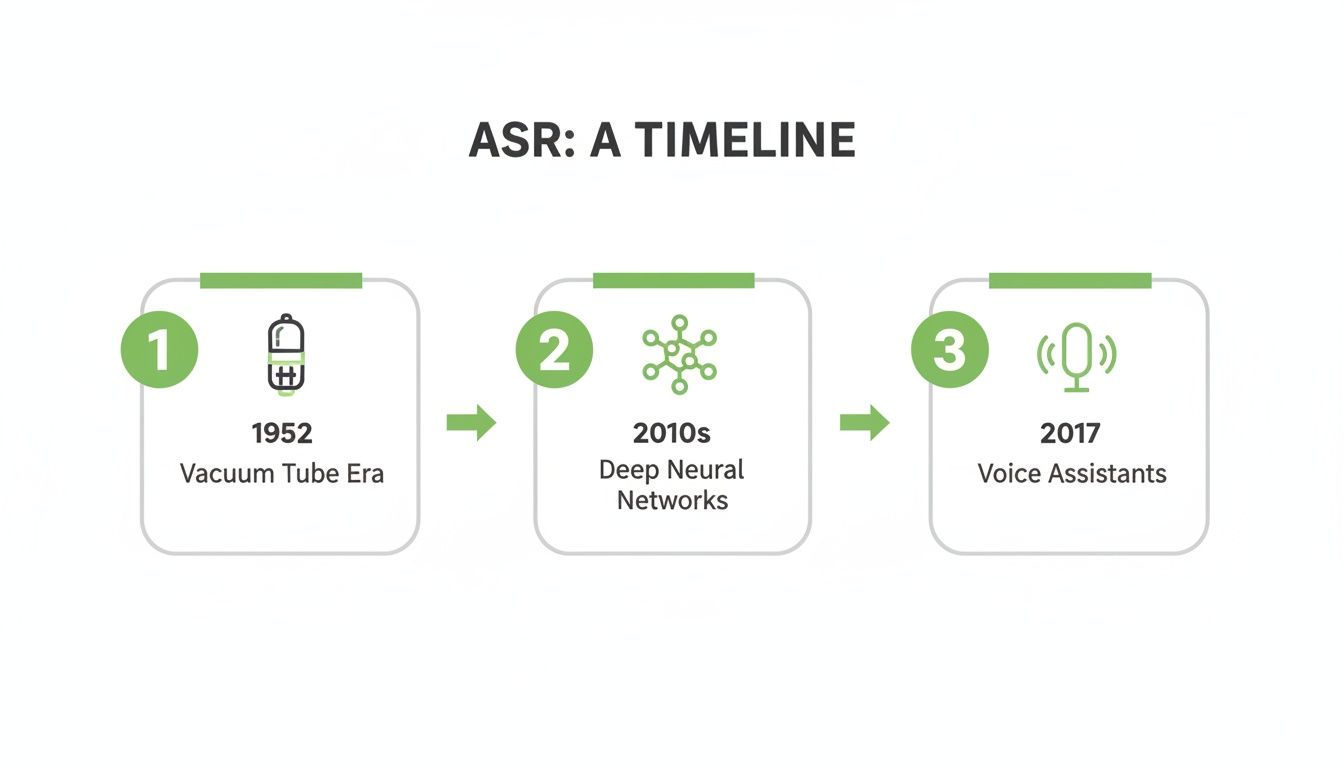
As you can see, the big leap happened in the 2010s with the shift to sophisticated neural networks. This breakthrough paved the way for the highly accurate voice assistants and transcription tools we have now. Today's ASR is a direct result of decades of this constant refinement.
ASR in Action: Transforming Industries Worldwide
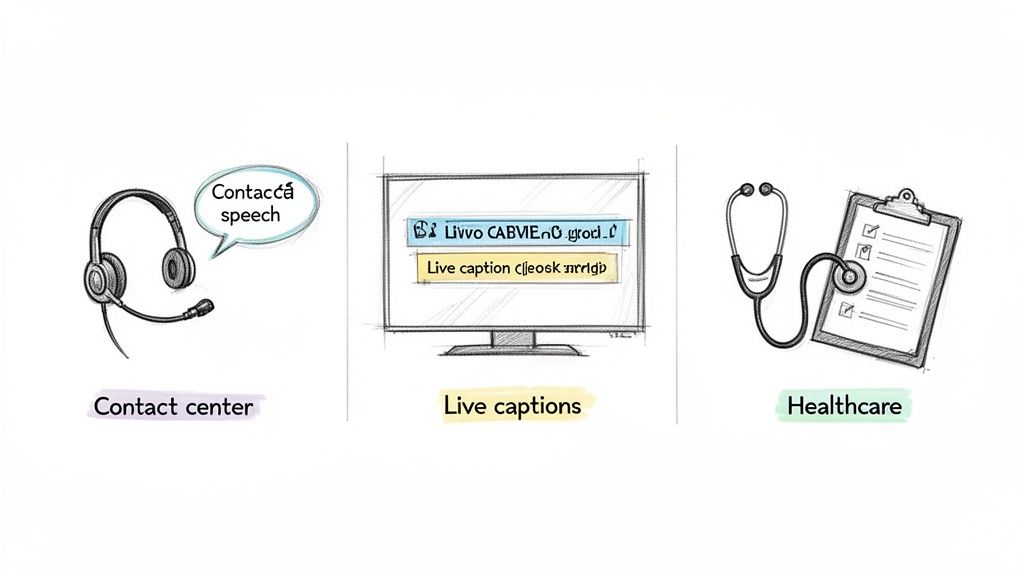
The theory behind speech recognition is interesting, but where ASR really shines is in solving real-world business problems. It's no longer a niche curiosity; it's a core component turning spoken words into valuable, actionable data across dozens of sectors.
Today's ASR is a perfect example of intelligent automation at work, fundamentally changing how businesses operate and how we all interact with technology.
Powering the Modern Contact Center
In customer service, everything hinges on understanding the customer's voice. ASR transcribes calls in real time, giving companies the power to automatically analyze conversations for customer sentiment, track agent performance, and check for compliance.
- Practical Example: A manager wants to know why customer churn is rising. Instead of listening to a few random calls, they use ASR to analyze 100% of call transcripts. They quickly discover that mentions of a competitor's "new pricing plan" have spiked by 300% in the last month, identifying the root cause in minutes, not weeks.
- To get a closer look at this in action, check out our guide on speech-to-text for call centers.
Making Media Accessible and Searchable
For broadcasters and media companies, speed is everything. ASR delivers live captions for news, sports, and online events, making content immediately accessible to deaf and hard-of-hearing viewers. It also transforms huge audio and video libraries into searchable assets.
- Practical Example: A journalist needs to find every instance where a specific public figure mentioned "climate policy" in the past five years of news footage. With ASR-generated transcripts, a simple keyword search scans thousands of hours of video and provides exact timestamps in seconds.
Instead of waiting hours for a human to transcribe a broadcast, media outlets can publish content with subtitles almost instantly. This not only meets accessibility laws but also boosts engagement and SEO by making video content fully indexable for search engines.
Reducing Administrative Burden in Healthcare
Physician burnout is a massive problem in healthcare, driven largely by endless hours of paperwork. ASR offers a direct solution, allowing doctors to dictate patient notes straight into electronic health records (EHRs).
- Practical Example: After a patient visit, a doctor dictates their notes using a mobile app: "Patient presents with a persistent cough and fever. No signs of congestion. Prescribing amoxicillin, 500mg, three times a day." The ASR system transcribes this directly into the patient's file, saving the doctor 10-15 minutes per consultation.
- This frees them from the keyboard and lets them focus on what they're actually there to do: care for patients.
These aren't just hypotheticals—the impact is measurable. For example, in the high-stakes world of customer experience, ASR systems like Vatis Tech's API now reach 98%+ accuracy, helping cut manual review time by 70%. Broadcasters use it to transcribe over 80% of live news feeds, and healthcare providers are reporting up to 40% faster documentation. ASR isn't just a convenience; it's a tool that delivers a clear and powerful business advantage.
Understanding the Metrics of ASR Quality
Not all speech recognition systems are created equal. While plenty of providers will boast about high accuracy, the true test of an ASR solution is how it performs on your specific audio—not some pristine, lab-quality recording.
To really judge quality, you need to look at the metrics that matter.
The main industry yardstick for measuring accuracy is Word Error Rate (WER). You can think of it as a "typo rate" for an AI transcription. It simply tallies up all the mistakes—wrong words (substitutions), extra words (insertions), and missed words (deletions)—and calculates an error percentage.
A lower WER is always better. For example, a WER of 5% means that for every 100 words spoken, the AI made roughly five errors. For most business needs, a WER below 10% is considered solid, while the top-tier systems can achieve rates under 5%.
More Than Just Accuracy
But here's the thing: a single accuracy score doesn't tell you the whole story. Real-world audio is messy. It's filled with background noise, people talking over each other, and a mix of different accents.
A truly great ASR system has to handle that chaos. Its quality goes far beyond just recognizing words correctly.
Here are the other critical factors you should be looking at:
| Feature | What It Is | Why It's Important |
|---|---|---|
| Speaker Diarization | Identifies who spoke when. | Essential for meeting transcripts or call center recordings to know which person said what. |
| Accent & Dialect Handling | Performs consistently across a wide range of accents without accuracy loss. | Critical for global businesses or companies serving diverse customer bases. |
| Noise Robustness | Tunes out background noise (chatter, traffic, music) to focus on speech. | A huge differentiator for call centers, in-field recordings, or public events. |
| Punctuation & Formatting | Automatically adds commas, periods, and paragraphs to improve readability. | Turns a raw wall of text into a clean, professional document. |
To get a much deeper dive into this core metric, check out our guide on what WER is in speech-to-text and how to calculate it.
When you're shopping for an ASR provider, always insist on seeing performance data on audio that looks like yours. Don't settle for generic benchmarks. That’s how you find a solution that will actually work for you.
What to Expect From Modern ASR Solutions
The gap between a simple voice-to-text app on your phone and a professional ASR solution is huge. While basic tools are fine for dictating a quick note, enterprise-grade platforms are built for something else entirely: precision, scale, and security.
These advanced systems, like the ones we build at Vatis Tech, go way beyond just turning words into text. They're designed to make sense of the messy audio that businesses deal with every day—where a single mistake in a transcript can have real consequences. The baseline for a serious platform starts with rock-solid accuracy, often hitting over 98% precision across dozens of languages and dialects.
A professional ASR solution isn't just a transcriber. Think of it as an intelligent data engine, built with the customization, security, and integrations needed to plug directly into your business workflows.
What Really Sets Enterprise ASR Apart
The true mark of a professional platform is its ability to solve specific business problems. A hospital needs an ASR that understands complex medical terms without flinching. A law firm needs one that can reliably tell different speakers apart during a deposition.
Here are the key features you should expect from any modern ASR solution worth its salt:
- Custom Vocabulary: This is your secret weapon. It lets you teach the ASR your industry's specific jargon, product names, or unique acronyms. It’s how you make sure terms like “pharmacokinetics” or “ISO 27001” are transcribed perfectly every single time.
- Developer-Friendly API: A powerful and well-documented API is a must. It allows your developers to build speech recognition directly into your own apps, websites, and internal tools, creating a smooth, integrated experience.
- Flexible Deployment: You get to choose. Whether you need a cloud-based service for speed or an on-premise solution for total data control, a modern platform gives you the flexibility to meet strict security and compliance rules.
- Top-Tier Security: This is non-negotiable. Look for compliance with standards like GDPR and certifications such as ISO 27001. Your data must be encrypted and handled with the highest level of security.
When you put it all together, ASR stops being just a transcription tool. It becomes a strategic advantage that helps you unlock insights from your audio data and automate critical tasks.
Frequently Asked Questions About ASR
To wrap things up, let’s clear up a few common questions that pop up when people first start working with speech recognition.
What Is the Difference Between ASR and Transcription?
It's easy to mix these two up, but the distinction is simple.
ASR (Automatic Speech Recognition) is the underlying technology—the engine that does the heavy lifting of converting spoken words into text. Transcription is the final output you get from that process: the text file itself.
Think of it like a baker and a loaf of bread. ASR is the baker who follows a recipe and uses an oven to create the product. The transcript is the finished loaf of bread you can actually use.
How Accurate Can ASR Get?
Under perfect conditions—like a crystal-clear studio recording—the best commercial ASR systems can hit over 98% accuracy. This is near-human performance.
But in the real world, accuracy depends entirely on your audio. Background noise, strong accents, overlapping speakers, or specialized industry jargon will all impact the results. That's why features like custom vocabularies are so important for hitting peak accuracy in a business setting.
Can ASR Understand Different Accents and Languages?
Yes, absolutely. Modern, top-tier ASR models are built using enormous and diverse audio datasets.
This training allows them to recognize a huge range of accents and dialects with impressive precision. A single powerful model can often handle over 50 languages, making it a versatile tool for global companies.
Ready to see what a professional ASR solution can do for your business? Discover the power of highly accurate, secure, and scalable speech-to-text with Vatis Tech and start your free trial.